
Solving for Why
How to turn abstract values into concrete action

A few months ago, I was in the early stages of redesigning an existing product — a website — and the scope we had been given was fairly narrow: move the site to a new platform so that it’s easier to maintain, and do some basic content maintenance in the process. Plain language, copy editing, broken links. Nothing major.
I had been auditing the existing content, reading about how the site was designed and used. Basically, it was a repository — a filing cabinet. A few key stakeholders would input useful information, then send links to individual pages to people via email when it was relevant. Nobody really “browsed” the site. But I was beginning to think that my team should change that. I thought that it could be something more, something better, even though that wasn’t what we’d been asked for.
I told a colleague this hunch, and they asked (smartly): “And how do you figure that out?”
I said something generic about how I run content audits, which even I found unsatisfying in the moment. But I kept thinking about that question in the following months as I worked on the project, because the question my colleague actually asked was much, much more interesting: How did I know that we should do something other than what we were asked for? More than that, how do we figure out what we should do — ever?
The problem with how we make decisions
In work and in life, we are offered an infinite set of choices about what to do at any juncture. It’s only natural that we resort to a handful of heuristics to make the thousands of decisions we’re faced with every day. Unfortunately, each of these decision-making approaches suffers from some weakness that we’re rarely completely conscious of.
“I’ll keep doing the same thing I’ve done before. If it ain’t broke, don’t fix it.” Tradition contains a lot of wisdom (see: Chesterton’s Fence — do not remove a fence until you know why it was put up in the first place), and you can’t upend your life or your business or your culture every day. However, if you are overly wed to tradition, you risk being caught holding stone tools when the tribe who has just discovered bronze comes running over the hill. Our assumptions must be regularly questioned.
“I’ll do whatever the relevant authority tells me to do.” Sometimes this is the only option. You have to do your job or you’ll get fired, you have to obey the law or you’ll be arrested, and you can succeed in many systems just by following the explicitly stated objectives. But humans are fallible. Your boss is human, rules are written by humans, and institutions are composed of humans, and thus they are often wrong in a technical or moral sense. Authority cannot always be relied on to provide the right answer.
“I’ll look at what other people are doing and copy them.” This is a more common approach than we often imagine. So many of our choices are based on what other people are doing. We shift imperceptibly in response to our peers, offloading some of our judgement to others. But even if we add the caveat that we’ll only copy smart, successful people, there’s no guarantee that you can recreate the insight that led them to their actions, which risks misapplication. Even when something works for most people, it can’t be relied on to work for us.
“I’ll do whatever is optimal. I’ll look for every advantage and take it.” Sure, that’s a good idea in the very broadest sense. It’s how we get better at things. Create a metric, pay attention to what affects the metric, tailor your tactics to ensure that it goes up as much as possible. You’ll get promoted, make more money, win more contracts, dominate the world. But oops, you’re evil again! The thing you really care about — happiness, independence, community — has been eroded by your single-minded pursuit of some metric or another (see: Goodhart’s Law — when a measure becomes a target, it ceases to be a good measure). You’ve got a lot of money, a big house, and you are an empty shell of a person who’s paving paradise.
“By process of elimination, I believe I’ve found the right answer: I will only make decisions based on my values. Truly, this is the best way of doing things.” Wonderful, you’ve figured it out — values! It’s settled. Except… what are our values? How do we apply them? How do they relate to each other? How do we put them into action?
Values-based decision making would be the default for every person on Earth if it made any intuitive sense whatsoever. We’ve spent millennia trying to encode any kind of meaning into words like “justice” and “integrity”, but they’re incredibly slippery and abstract. We may think that we are acting in line with our values when we’re actually resorting to one of the other heuristics outlined above. You want racial justice, you get black squares on Instagram.
That, really, is the challenge I want to answer: how do we turn our values — which are necessarily abstract — into concrete action?
The answer, I think, is that we should start with “why”.
A framework for values-driven strategy
I first heard this idea in a TED Talk about 15 years ago. Or rather, I thought I did.
I recently went back and watched Simon Sinek’s Start with why – how great leaders inspire action. He argues that some of the most exceptionally effective companies don’t just sell great products, they sell their own motivations for building those products. “People don’t buy what you do, they buy why you do it.”
To illustrate his point, he draws what he would later call “the Golden Circle”. It’s three concentric circles — WHY, within HOW, within WHAT.
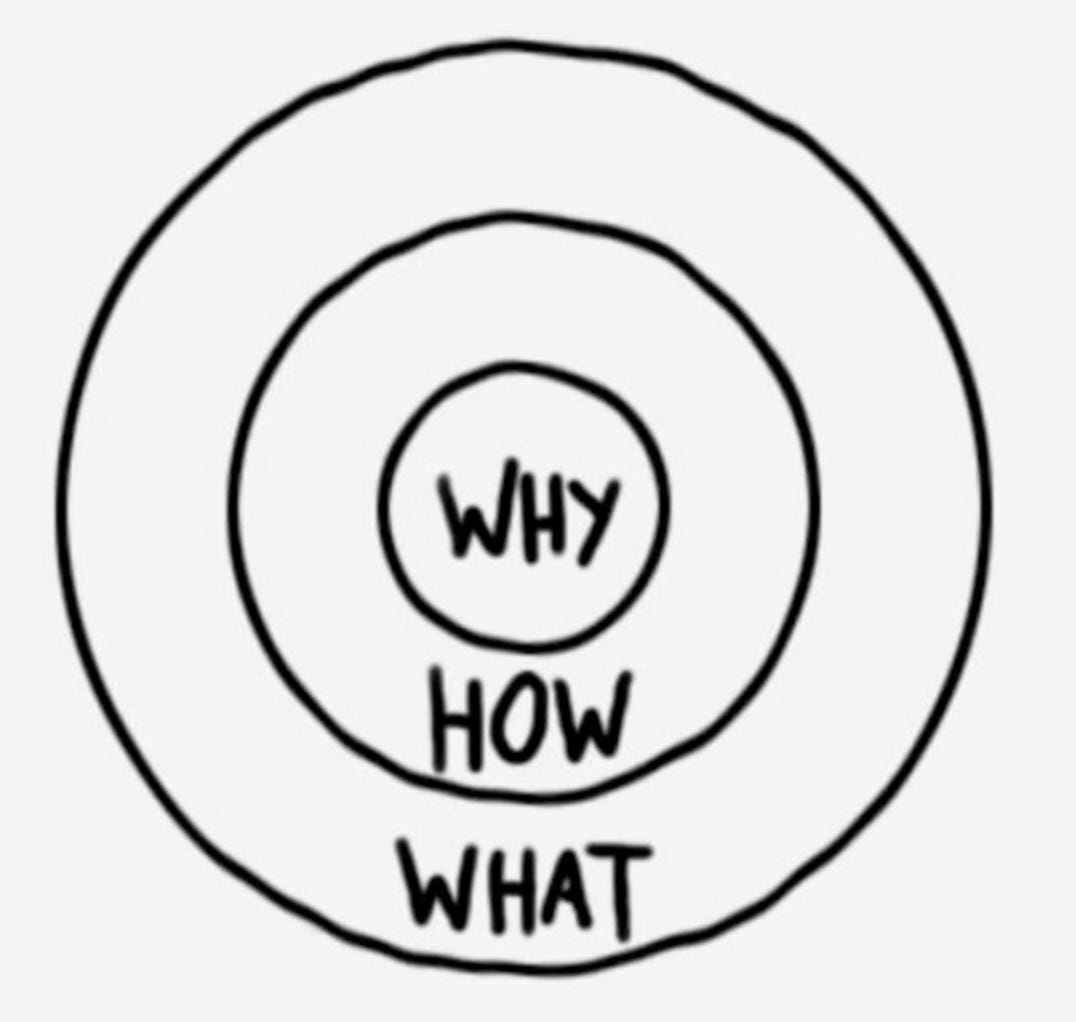
If you want to persuade people to buy into your products and ideas, he says, start with why, then how, then what. “We believe in innovation” > “That’s why we’ve designed this computer this way.” > “Here’s the computer. Want to buy one?”
What’s interesting to me now is the way this idea mutated in my head in the years since I last saw it. I have never really been someone who sells things. The only exception might be getting internal buy-in for my ideas, but “Frame your ideas in the interest of the other person” is Dale Carnegie stuff — nothing especially radical. Instead, the Golden Circle became a way of thinking about strategy.
When I’m in a situation where I have to figure out what to do, I find that the heuristics I mentioned previously offer answers almost immediately — do what you’ve been asked, do the optimal thing, do the thing other people are doing. I hope that I have chosen to follow my values more often than not, but it’s exceptionally difficult to tell what’s a genuine and reasonable impulse and what’s motivated reasoning.
I have found the Golden Circle a helpful framework time and again for confronting these sorts of issues, if only because it reminds you that “why” is a question worth asking. This might seem obvious, but I’ve been in many meetings where I said, “Yeah, but why are we doing this?” and my colleagues found it to be a genuinely valuable contribution.
When you ask why, you will naturally generate a laundry list of reasons, justifications, and motives — and there is no substitute for determining your values and what’s worth caring about — but the Golden Circle offers a constructive framework for sifting through these answers. Make a bunch of post-it notes with every possible answer, then ask yourself: what here is a motivation, what’s a method or approach, and what’s a tactic?
Tactics are contingent, they can change by the hour to meet the needs of the moment. Methods and approaches are firmer, they constitute your beliefs about the right way to do the work, and they evolve over time. But your motives are deep-seated. Despite being incredibly abstract, they are also foundational to who you are and what you do.
Maybe what you really care about is making money, in which case, “optimize everything, become evil” is a legitimate choice, and you’ll become a drop-shipper or a crypto miner or whatever it is that makes a buck.
Or maybe you’re trying to decide on a career. Years ago, a friend of mine was studying to become a dentist. He didn’t really want to be a dentist, but his parents wanted him to be a dentist. If you’re the type of person whose core value is “do whatever makes you happy”, you might have advised my friend to quit dental school. But my friend really cared about filial piety, and while it’s not the choice I would have made for myself, staying in dental school was the choice that aligned with his values.
Three examples
Lest you think this is just more think-boy epiphany-chasing, I want to show you that this framework actually works. It’s practical, lightweight, and easily applied.
Years ago, I was sitting in a diner with a friend of mine. They worked at a nature center and they explained to me that the organization that ran it was in the middle of a fight about their strategic plan. They showed me the organization’s mission statement on their phone and I saw the problem immediately:
Our mission is to inspire an appreciation for the beauty and value of native plants and a commitment to support the habitats that sustain them.
That looks like a pretty good mission on the surface, but it was leading to a real headache: Some of the staff argued that making nature accessible to the public was the most important thing, and others argued that preserving the nature center’s rare and beautiful ecology was the most important thing. These two objectives were sometimes in tension, but they both appeared to be supported by the mission statement.
I asked my friend some follow-up questions about the origins of the organization. I tried to locate the different parts of their work — their motives, their approaches, and their tactics — and put them into order. Then I grabbed a napkin and sketched out a revision. It was something like this:
Our mission is to inspire an appreciation of native plants and a commitment to protecting their habitats by making [the nature center] accessible to the public.
The difference between the two versions is that mine makes clear what motivates their work and how that motivation leads to their approach. It starts with why, moves on to how, and leaves what to daily operations.
I used this framework more intensively when I was a policy analyst at the Pennsylvania Department of Aging.
I facilitated the development of the next version of their State Plan on Aging — a plan they remade every four years. For the year prior to writing the new plan, I had sat in on monthly, hour-long meetings where department heads gave updates about how they were meeting the last plan’s objectives. We would go around the room and each person would start by reading the relevant objective out loud — not because it’s what they had been asked to do, but because they needed the room to hear the abstract mess that they were trying to comply with. They followed their recitation by looking baffled and exasperated, then attempted to work backward from the work they actually did to the objective they were trying to meet.
When I went about rewriting the plan, I talked to the department heads about what they thought we needed to accomplish in the coming years, and by contrast, they were calm, colorful, and incisive. They knew what was important and they had some sense of how we should do it. I didn’t ask them to write objectives themselves, I just noted what they said and later sorted it into motivations, methods and approaches, and tactics. This allowed us to connect our motivations and ideals with the actual work we were doing day to day, and allowed departments to be more flexible with how they met those goals.
The third example is my own work. There were a number of ways we could have looked at our work:
We could make an incremental update to the existing site, smoothing some rough edges.
We could read our given task very thoroughly and literally and then do precisely what we’d been asked.
We could have come up with some metrical approximations for some version of success — like site traffic — and optimized for that.
Or if we were optimizing for compensation, we wouldn’t be paid more for radically changing the site, so why bother?
Instead, I asked “What’s the actual mission of this thing?”
Reading through documentation, there were a number of different stated goals and objectives, but the common thread was improving outcomes for the people this resource was designed to serve. So how do we do that? The theory behind the original site was that practitioners in this field were often reinventing the wheel, so collecting and sharing proven strategies would help them work more effectively. That’s what the site did — it assembled information for professionals to reference.
With those answers in hand, I could address what we should do. If the goal was improving outcomes by sharing information with professionals, shouldn’t this be a resource they returned to regularly? We redesigned the site to fit practitioners’ mental models and gave it a more flexible structure so it could grow and change. By becoming more connected to its users rather than functioning as a static repository, it could better serve its mission.
So Sinek was right. People don’t buy what we do, they buy why we do it. But why do they buy why we do it? I think it has something to do with trust.
As with high school math tests, it’s not just about getting the right answer, it’s about how you arrive at it. You and I may agree on something important today, but if I don’t understand how you made that decision, I don’t know whether I can trust the decision you’ll make tomorrow. This is why we sometimes find that we respect our opponents but do not trust our allies — for the purposes of building trust, making decisions with integrity matters as much or more than making the right decisions.
Right now there are people out there spilling a lot of ink on a problem that they call human-AI alignment. Fundamentally, they’re trying to figure out how we ensure that AI has some integrity, that there’s some relationship between its values and our values. Because up until this point, we’ve only been able to influence what it does, not why it does it. That’s what makes it so hard to trust. And the funny thing is, we haven’t even figured out human-human alignment yet; we regularly act out of step with the values we profess. This framework helps to address that, making it clear where decisions flow from.
There’s no way to guarantee that you will always make good decisions, but with this framework, you can ensure that you always make decisions with integrity.
i really appreciate your articles. thanks again :)