
Despair is a broken compass
On the power of prefigurative belief

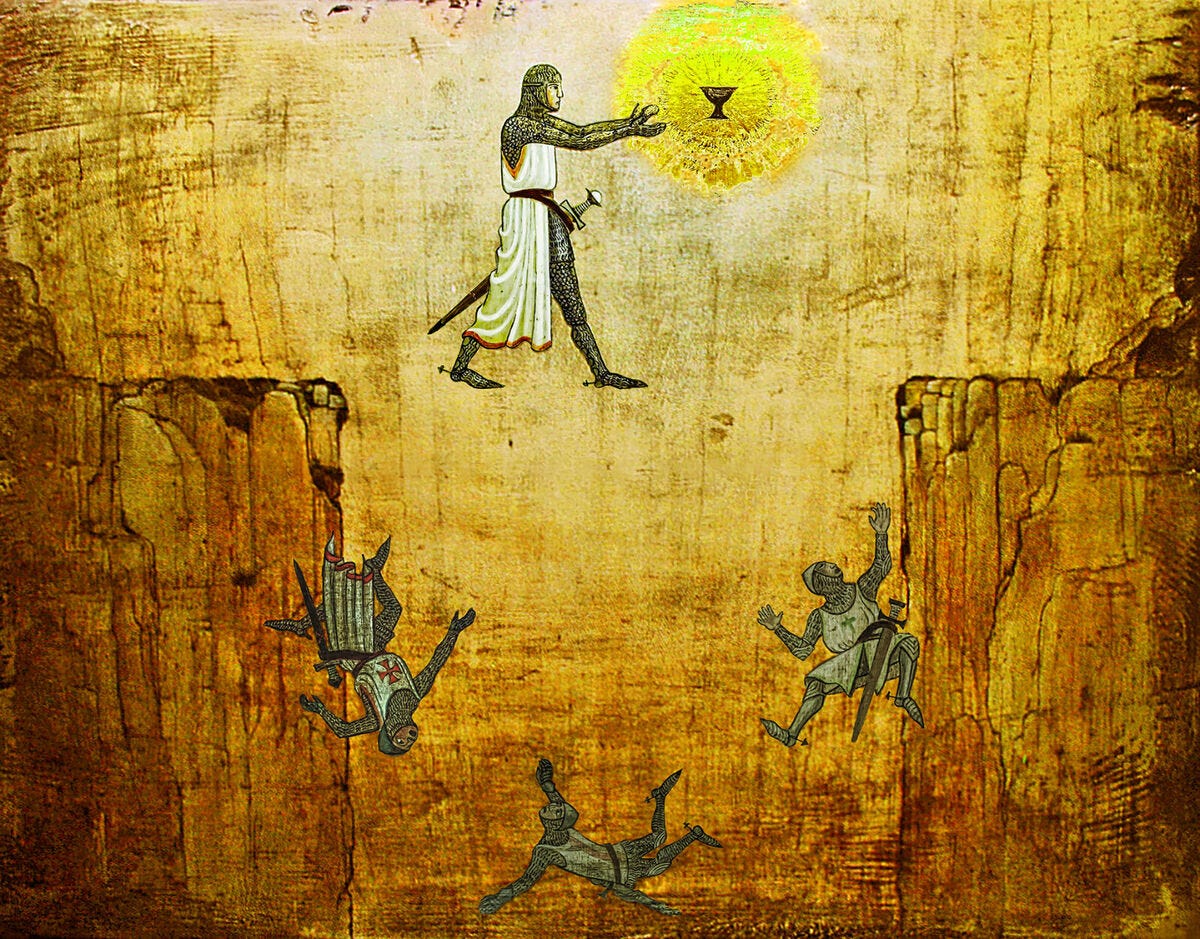
Many people are pessimistic about the future right now. Whether it’s in regard to inequality, climate change, or fascism, there's a prevailing sense that things are bad and can only get worse.
Some would even say that they know doom is inevitable. We're screwed, there's no way out, and the only rational response is despair. These are just the facts.
I am not immune to sudden bouts of anxiety about the forces banging at the gate. Some of our problems are massive and growing, and we don't really know what to do about them. That’s enough to make anyone anxious.
But any Utopian worth their salt is at least a bit skeptical of Certain Doom, and not because of some naive optimism that insists everything will be alright in the end. Utopians simply have a different theory of historical change.
The rational argument against Certain Doom
If I were trying to persuade someone to let go of their doomerism, I might be tempted to resort to reason.
I could cite statistics and point to graphs that suggest that many important factors have actually been trending in the right direction for a while now: global poverty, child mortality, and illiteracy have decreased, while economic growth in low-income countries, clean energy investments, and social spending have increased. The COVID-19 pandemic response saved millions of lives, and while climate change remains a serious threat, the worst-case scenarios are becoming less likely by the day. (Noah Smith does a pretty good job of making this argument.)
Of course, there's always another statistic or problem to cite in rebuttal: biodiversity loss, wealth inequality, the mental health crisis, plastic pollution, and the still very real terrors of climate change even in a best-case scenario.
In my estimation, neither side can fully prove their case. Many things are better, and many things are worse, but a litany of improvements or failures doesn't add up to a theory of the future. If you were an optimist or a doomer before such an argument, you're likely to be one after.
The problem is that these sorts of beliefs aren't born of rationality. As the saying goes, "if you didn't reason yourself into something, you can't reason your way out of it". Certain Doom isn't a fact, it's a feeling.
So the question becomes: Why do we feel like we're Doomed?
Perhaps it's something innate to our species. After all, humans have been predicting Certain Doom since the beginning of human history. Before rogue AI and climate change, it was solar flares, the Yellowstone supervolcano, ultra-fatal pandemics, the Mayan calendar, Y2K, nuclear winter, Malthusian collapse, peak oil, Ragnarok, Judgement Day...
Étienne Fortier-Dubois suggests that this may result from a cognitive bias favoring simplistic scenarios. Basically, envisioning the future is very complex, but predicting doom is very simple: everything from here on out goes wrong and it's all broken forever, the end. To this I'd add negativity bias (over-weighting negative information), availability heuristic (relying on information we can easily recall, like catastrophes), and confirmation bias (seeking information to confirm our intuitions).
While these are all failings our ancestors had as well, we may be uniquely inclined toward doomerism due to our media environment:
Incentives for traditional and new media companies to produce negative content are stronger than ever as they race to monetize every second of your attention.
By creating a distorted reality that contributes to anxiety, depression, and loneliness, social media is causing the aforementioned mental health crisis.
Progressives have valorized outrage and depression, thereby giving the crisis a partisan dimension.
We're living through an epistemological crisis that makes it impossible to tell exactly how bad things are, and it’s hijacking the traits our ancestors evolved to stay alive in a world more dangerous than our own. We ask ourselves "what's going to happen in the future?" and our poisoned minds can't muster a drop of hope. We become depressed and demoralized.
But prediction is always a fool’s game; even the experts can’t do it. In his work on forecasting, Philip Tetlock found that while experts may know a lot about their field, when it comes to predicting the future they are as accurate as chimps throwing darts. And the further out they try to predict, the worse they get. Past five years their odds are as good as chance.
However, Tetlock also found that 2% of experts were superforecasters who were able to see the future more clearly. What makes them different? Their philosophical outlook: nothing is certain, reality is infinitely complex, and what happens is not necessarily meant to be.
Prefiguring Utopia
I’d love to make the argument that everything is going to be just fine, but unfortunately, I don’t have sufficient evidence to support that. I can only point out that our compass is broken and we must find another way to navigate. Despair is obviously not a healthy or productive response to the world, but it also isn’t a rational one, so we need an alternative.
Perhaps you will object that we shouldn't believe anything we don't have evidence for. William James, the father of American psychology and the philosophy of pragmatism, argued against evidentialism in his 1896 essay, The Will to Believe.
James said that in life we sometimes face "genuine options" — choices that are:
"Living" (personally meaningful and relevant)
"Forced" (we cannot abstain from choosing)
"Momentous" (the decision has significant consequences)
If you are faced with a genuine option and insufficient empirical evidence, he argues, it is permissible and even beneficial to choose some beliefs using our "passional nature" — our emotions, desires, and will.
Clearly, whether or not we should believe in the possibility of a better future is a genuine option. It is meaningful to everyone, we act on our assumptions regardless of whether we make a conscious choice, and it has massive consequences. Thus it is sensible that we should choose the right belief on other grounds: the impact it has on us and the world
The question then is how we should go about acquiring a healthier, more sensible relationship to the future. Some, including Matthew Yglesias , have suggested society-wide cognitive behavioral therapy (CBT) to reframe our harmful beliefs. Alex Olshonsky has argued that we need to return to a more holistic, animistic perspective that reclaims ritual, connection, and the poetic.
I don't dislike either of these answers, but Utopians have our own approach. I call it: prefigurative belief.
To prefigure means to represent, suggest, or anticipate something before it comes to pass, thereby shaping or influencing how it manifests. That makes it sound pretty grand, but you actually prefigure things every day. You lay out the clothes you want to wear tomorrow, you make to-do lists, you practice for an interview in the mirror, you talk about where you'd like to live and trips you'd like to take. These small acts of anticipation shape how things actually play out.
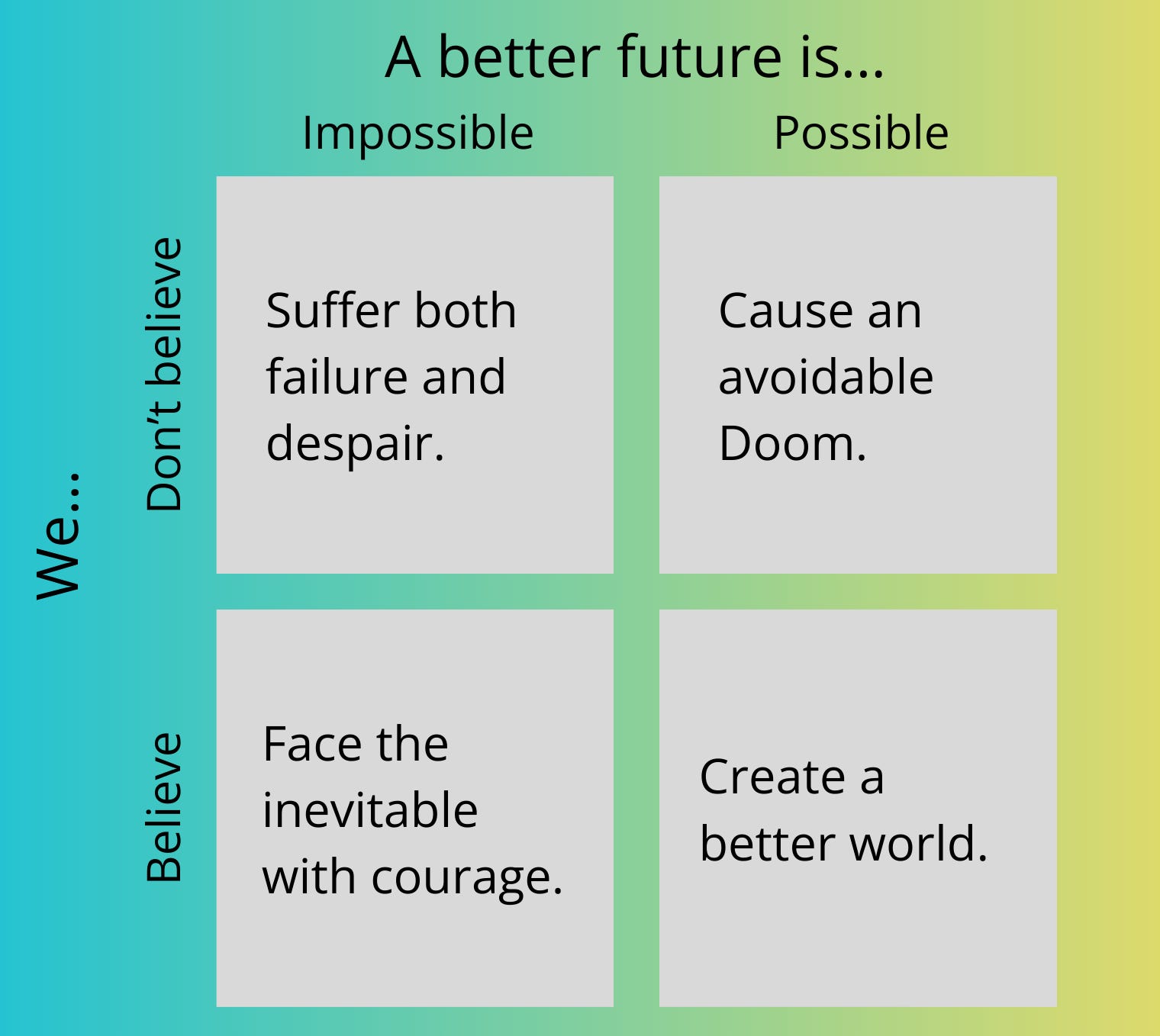
Prefigurative belief is the same idea but directed at things that are more distant, more ambiguous, more important — the unknowns of our individual and collective futures. With prefigurative belief, we vividly imagine a better world, believe in its possibility (not inevitability), speak of it, and act as if it will occur.
It was prefigurative belief when — in a time when interracial relationships were still taboo — Star Trek imagined a future where a kiss between Captain Kirk and Lieutenant Uhura was not just acceptable, but unremarkable.
This is not a new idea, simply a new formulation. It has been called hope, dreaming, imagination, optimism. All of these names represent some part of the idea, but none of them capture the way the utopian uses it and the power that it holds.
Prefiguration is a kind of self-fulfilling prophecy. According to Robert K. Merton, father of modern sociology, self-fulfilling prophecies occur when our expectations or beliefs about a situation or person lead to behaviors that cause those expectations to come true. A teacher believes in the promise of a student, invests in them, and they succeed. An athlete believes they can win a race, they commit themselves to the effort, and they win. Obviously, mere belief in a better future isn't sufficient to bring it about, but it may be necessary.
I think it's important to point out that this makes prefigurative belief a grounded approach to the future. It is not naive optimism; our problems will not simply solve themselves and we cannot afford to be complacent. Nor is it manifestation; we are not merely attracting something we want through magical thinking.
Self-fulfilling prophecies work because the belief leads to action. We envision the future, which changes how we think, which changes how we speak and act, which changes how others think and speak and act. Together, we form positive, collective visions of the future and coordinate the work necessary reach it. Prefigurative belief is a star that lights the way.
"There is nothing like a dream to create the future."
— Victor Hugo
Mundane forms of prefiguration aren't super spiritually taxing — maybe our dinner plans for tomorrow will change and we'll just have to deal with it — but prefigurative belief demands true courage, the courage to not be overly "realistic". If we look at the past, we see a long chain of unpredictable and dramatic changes. To cling so tightly to what you think is possible that you unnecessarily narrow the possibility of the future is unrealistic in its own way.
The philosopher Ernst Bloch said, “The most tragic form of loss isn't the loss of security; it's the loss of the capacity to imagine that things could be different.” His great work was called The Principle of Hope, and indeed, that is basically what prefigurative belief is: hope that is chosen because it works.
Prefigurative belief changes us
However, I still think I’m underselling the power of prefigurative belief. It is more than just a practical strategy for the future, it's a spiritual position that enables self-transformation.
We have never been completely in control of ourselves. The age-old question of nature-versus-nurture doesn't even entertain the possibility of autonomous change or self-formation. We take for granted that our biology and environment have always conspired to make us.
But now there are other forces trying to slowly and invisibly turn us into their creation: the market and the algorithm. Millions of actors exert their will through these channels every day, trying to nudge us in the direction they want us to go for their own petty, selfish reasons. Corporations want us to be more passionate consumers, enemy nation-states want us to be conspiracy theorists, and media platforms want us to be ever more viral versions of ourselves. One need only look at one’s phone to see the mutation in real time.
While these are immensely powerful behavior modification structures, they aren't the only ones. The ancient philosophies and great religions of the world show us that we all have the power to believe in something beautiful and allow it to change us.
The philosopher Pierre Hadot said that the philosophy of antiquity wasn’t merely a way to know and categorize things: ”Philosophy was a way of life, both in its exercise and effort to achieve wisdom, and in its goal, wisdom itself. For real wisdom does not merely cause us to know: it makes us 'be' in a different way.”
I believe that prefigurative belief — and by extension Utopianism — has this power. Prefigurative belief casts off the yoke of optimization and combats the coercive forces of the world by creating a new, parallel incentive structure. It aligns our personal convictions, expectations, and behaviors toward an envisioned destination. It changes us in a way that we choose.
Previously, I've said "If Utopia is a dream, Utopians are the ones who dream it." We imagine, we anticipate, we prefigure, and in doing so we are transformed.
Thank you so much for reading this essay. If you enjoyed it, I hope you’ll subscribe and join me for more adventures in Utopian thought.
The thing about externalities is, they're hidden. We are, in fact, Doomed! Our technology has exponentially outpaced our ethics and it's easier and easier to accidentally destroy the world every day. The right people aren't in power, never have been. There are no ethical geniuses in government or big business.